Introduction to Accounting: Concepts and Applications

V2.0

Accounting as a Second Language

The AME Learning System™ is a unique patented teaching approach that is proven to work. Designed to teach non-financial managers in the business world, the AME Learning System has evolved to include outstanding accounting courseware for higher education.

Our system incorporates the best of cognitive science, modern technology, and proven learning principles into an active and experiential learning approach that emphasizes constant decision-making, integrated real-world examples and impact over memorization.

With the AME Learning System, students work through multi-sensory interactive online tutorials and learn the key concepts they need to know before they arrive in class. Prepared students mean classroom instructors can focus on the application of core concepts. Instructors have the power to set deadlines and milestones for all resources (including pre-class tutorials) to build a customized course that works for them — and their students.

Features:

basic accounting
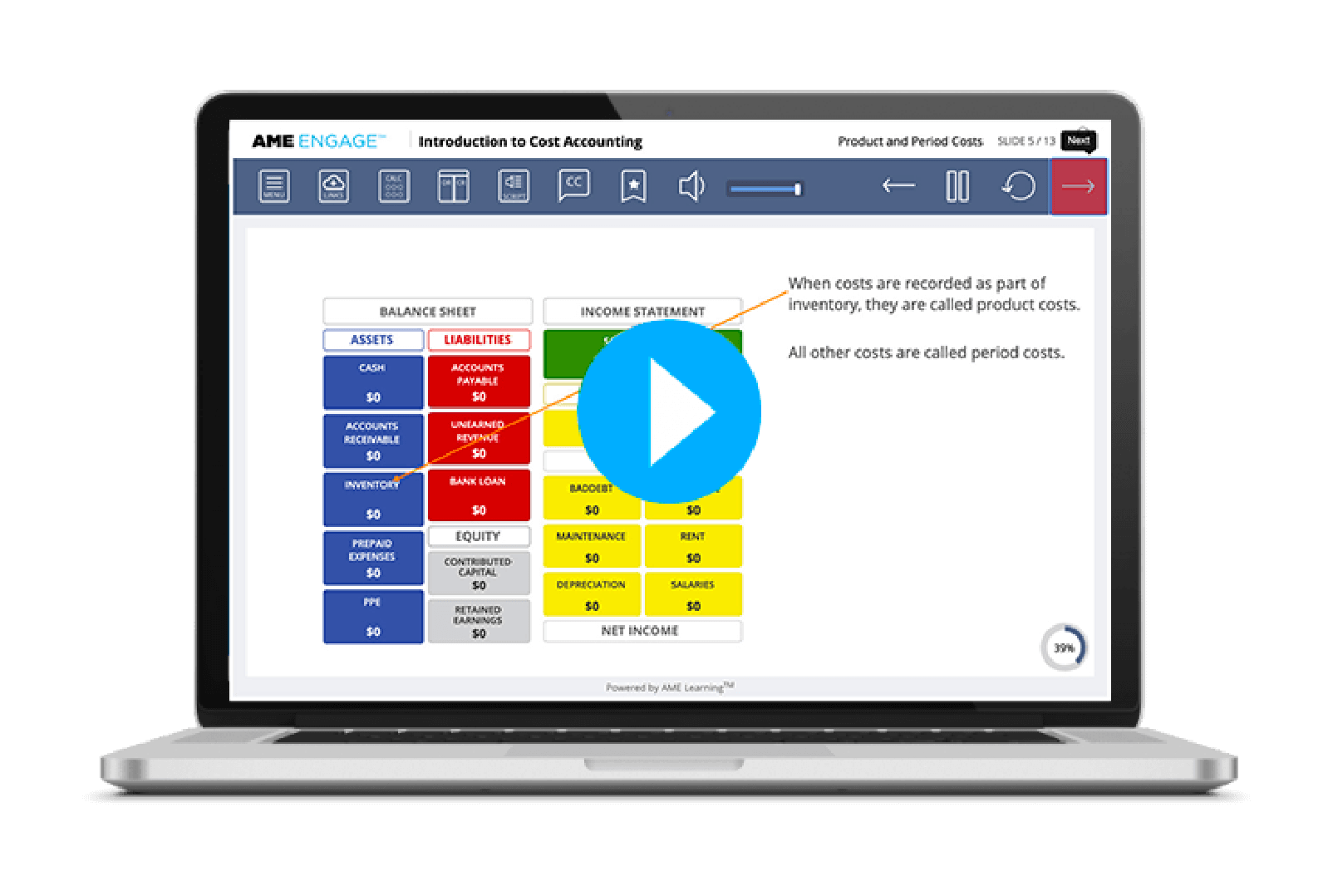
Upgraded Accounting Map™ Tutorials including new interface, pause control, closed-captioning and menu mapping.
basic accounting

E-Workbook Evolution means workbooks are available as fillable PDFs.

accounting courses online
basic accounting
All Resources Accessibility Compliant.
basic accounting

Enhanced Workbook includes new problems added providing greater variety and complexity.

basic accounting
Improved AME Engage™ learning analytics for tracking of progress on learning objectives.
accounting courses online

Student Courseware

Overview

Introduction to Accounting: Concepts and Applications is designed for the non-accounting manager who must have an understanding of financial and managerial accounting as it is used in decision making. The textbook provides an accessible introduction to accounting for students coming to the subject for the first time. It embraces the basic techniques and underlying theoretical concepts in accounting and shows how these are applied in various circumstances. Students learn about annual reports, financial statements, balance sheet accounts and accounting transactions and the focus is on how accounting information is used in decision making, not on the mechanics behind that accounting information. A full introduction and practice of the accounting cycle will be presented followed by accounting application topics used in business today. Application topics include cash management, fraud prevention, receivables analysis, depreciation basics, payroll, financial statement analysis and more.

What’s New

New and Revised Textbook Features
The textbook includes new content, revisions and updates to make it as current and accurate as possible. Key points are outlined in the “Chapter Changes” section below.

New Workbook Features
The workbook features a new section of Practice Questions in every chapter. These questions focus on individual concepts and calculations for each learning objective. They provide introductory practice before students move on to the more detailed and complex Application Questions.
The workbook also includes new Application Questions throughout the chapters to expand the range of difficulty and offer different approaches to the topics.
Selected workbook questions are available in Microsoft Excel format for download from AME Engage™ (posted within each chapter). These questions are marked in the workbook with an icon after the learning objective number.

Chapter Changes
Chapter 1: Financial Statement: Personal Accounting
A brief new section introduces the concept of capital increases to net worth such as gifts or lottery winnings.
The section on ethics in personal accounting has been removed. Accounting ethics is introduced in Chapter 2.

Chapter 2: Linking Personal Accounting to Business Accounting
New timeline diagrams in the sections on recording revenue and recording expenses help students visualize when revenue and expenses should be recognized in different scenarios.

Chapter 3: The Accounting Framework
The discussion of partnerships has been expanded to include a brief description of the different types of partnerships.
The section on the ethics of accounting has been revised to present sample ethical standards in plain language, to make them more understandable to students.

Chapter 6: The Accounting Cycle: Statements and Closing Entries
A new “GAAP vs. IFRS” box explains how often financial statements must be prepared under each system.
The final section on computerized accounting systems has been revised and updated.

Chapter 7: Cash and Internal Controls

Expanded definitions and examples of internal controls for cash are included. A new explanation of segregation of duties has been added.
The section that discusses control of cash receipts has been revised and reorganized to provide a better flow of information.

Chapter 8: Accounting for Receivables
Revenue recognition criteria in the sale of goods and services are presented in context within this receivables chapter.

Chapter 9: Inventory: Merchandising Transactions
The comparison of perpetual and periodic inventory systems has been expanded. It now explains the concept of an inventory count and how that affects the accounting.

Chapter 10: Accounting Information Systems and Data Analytics
A new learning objective is dedicated to data analytics. An online module on AME Engage™ applies that introductory information about data analytics, providing a comprehensive data set and step-by-step exercises.

Chapter 11: Long-Term Assets
Recent financial information from JetBlue Corporation and Newmont Corporation are used to demonstrate concepts related to long-term assets.
A new “GAAP vs. IFRS” box highlights the concept of component depreciation.
A brief section introduces the revision of depreciation estimates and the concept of impairment.

Chapter 12: Current Liabilities
The order of presentation has been changed to move payroll liabilities later in the chapter. A brief section early in the chapter introduces the concept of accrued liabilities, setting up that later discussion of payroll.

Chapter 14: Financial Statement Analysis
Throughout the whole chapter, the financial statements of Tilly’s Inc. are used to provide a real-life analysis.
A new section on computerized financial accounting briefly introduces tools to increase efficiency and ensure decision-makers have access to current and accurate information.

Contents

Chapter 1: Personal Accounting
Chapter 2: Linking Personal Accounting to Business Accounting
Chapter 3: The Accounting Framework
Chapter 4: The Accounting Cycle: Journals and Ledgers
Chapter 5: The Accounting Cycle: Adjustments
Chapter 6: The Accounting Cycle: Statements and Closing
Chapter 7: Accounting for Cash: Internal Controls and Fraud Prevention
Chapter 8: Accounting for Receivables
Chapter 9: Accounting for Inventory
Chapter 10: Accounting Information Systems
Chapter 11: Accounting for Long-term Assets
Chapter 12: Accounting for Liabilities and Payroll
Chapter 13: Decision Making with Accounting Information
Chapter 14: Analyzing Accounting Information

For Students

AME Engage™

AME Engage™ is an online, interactive component of the AME Learning System featuring the Accounting Map™, a digital and highly visual interactive balance sheet and income statement for powerful and practical transactional learning. Students will access Interactive Pre-Class Tutorials, Quizzes, and Post-Class Homework. Plus, a digital textbook and workbook allow students to quickly access homework related questions and subject matter.

For Instructors

AME Assistant™

Our AME Assistants act as your teaching assistant to help you create and curate your course and its materials. We customize experience, content, and your support because we know our customers personally. We ensure our technology is portable and interoperable with your platforms while organizing our materials to match your needs and processes, giving you more free time to focus on what matters most: your students!

college-accounting

Get Your
Personal Demo

Interested in learning more about the AME Learning system? Just fill out this form, and let’s get started!
  • MM slash DD slash YYYY
Shopping cart0
There are no products in the cart!
0